Homemade Slime
An hour making homemade slime for kids with a reliable glue-and-activator method, then color labs, stretch tests and storage that keeps it usable for days. Mess stays manageable and the results feel like a win, not a science gamble.
Last updated
Before you start
Slime earned its reputation the hard way — recipes that never set, and carpets that never recovered — but the modern recipe is genuinely reliable: PVA glue, a pinch of bicarb, and contact-lens solution added drop by drop (its boric acid is the activator; the drop-by-drop is the whole skill). Stir until it releases from the bowl, knead until it stops being sticky, and you have proper slime — stretchy, pokeable, obedient.
The activity's real shape is a chemistry lab wearing a toy's clothes: the activator visibly transforms the mixture (polymer chains linking, if anyone asks — and someone always asks), the colour stage is controlled experimentation, and the stretch-test Olympics afterward generates data, records and disputes. The containment protocols — tray, apron, tub — are part of the fun when they're framed as lab rules.
How it goes
Lab setup
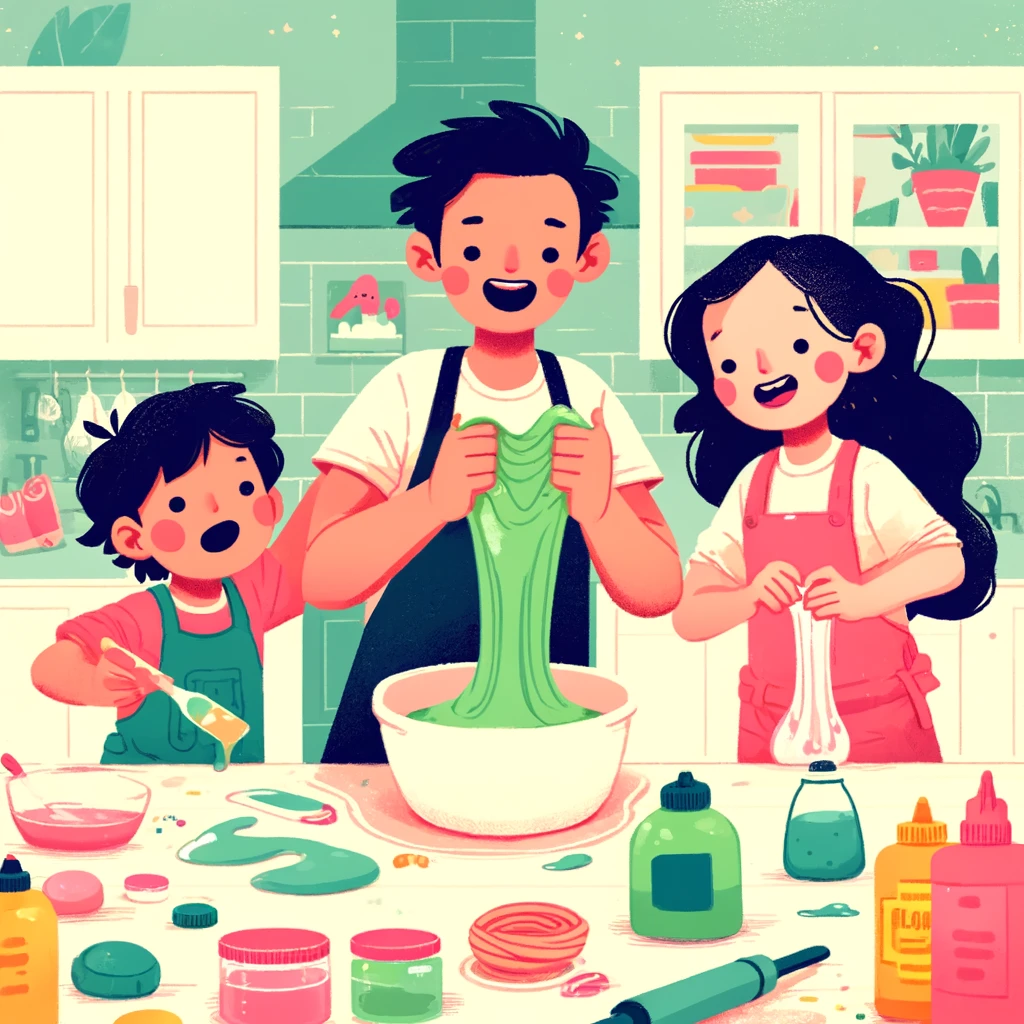
Aprons, tray, bowls, and the lab rules stated — slime stays over the tray, hands stay off the sofa, and the activator bottle is the adult's instrument. Glue into bowls (the whole small bottle; under-glued slime disappoints), bicarb pinch stirred through.
Colour chemistry
Colouring added drop-wise and stirred — the moment for controlled experimentation, because colour mixed into glue behaves visibly (two drops blue plus one yellow, and the green arrives slowly through the stir). Glitter now if ever; glitter added late haunts the kitchen for a season.
Activation
Contact-lens solution added a few drops at a time, stirring between — the transformation is gradual then sudden, as the mixture releases the bowl's sides and gathers itself. Under-activated is sticky (add drops); over-activated is rubber (no road back — the lesson in irreversibility every lab eventually teaches). Then the kneading handover, where hands finish what the spoon began and the slime becomes itself.
The materials-testing division
Stretch tests (slow pull for distance — the two-metre club is real; fast pull for the snap), the poke register, bubble-blowing through a straw for the advanced, and the tray-bounce. Records logged, slimes named, and the closing ceremony — every slime into its labelled tub, because tubbed slime lives a fortnight and loose slime lives on the carpet, briefly, forever.
Make it fit your kids
This one waits, honestly — the borax-adjacent chemistry and the mouth years don't mix. Their parallel station is playdough with the same colours, same table, zero envy if sold with conviction.
The heartland — they run colours, stir the activation and take the stretch records personally. The naming of slimes reaches literary heights here.
Recipe variables become the game — glue brands compared, fluffy slime (shaving-foam variant) trialled, activation thresholds logged like scientists. Their tubs get labels with batch numbers.
Texture-engineering territory if they're in — butter slime, clear slime, the satisfying-video aesthetic — or a clean pass, no offence taken. The younger kids' lab benefits from a cynical quality controller either way.
One bottle of school glue and a pharmacy own-brand lens solution make several batches — a couple of pounds all-in, with colouring from the baking drawer and the tubs from the takeaway cupboard.
If it’s going really well
- The variable trial — three batches, one variable changed each, results tabled on the fridge like the science it secretly is.
- Fluffy slime — the shaving-foam variant, doubling the volume and the drama.
- Slime-stretch cinema — slow-motion phone footage of the records, which is the satisfying content the internet built an economy on.