Indoor Scavenger Hunt
An indoor scavenger hunt for kids that runs in under an hour: clues with clear progression, simple hiding rules, and age-based difficulty so siblings can play together without chaos.
Last updated
Before you start
Any list of objects makes a scavenger hunt; what makes a good one is clues that require thinking rather than fetching. "A spoon" is an errand; "something that's been in this family longer than you have" is a puzzle, a conversation and a story when they bring back Grandad's tankard.
The formula for clues that work: describe the property, not the object — something softer than a cat, something that makes a noise you like, something red that isn't meant to be. Ten clues per hunt, mixed difficulty, one deliberately funny. Writing the list takes ten minutes; hunters take three times that, at full volume, which is the exchange rate this activity has always offered.
How it goes
The list
Write ten clues using the property-not-object rule, tuned to your hunters — colours and textures for little ones, riddles and history for bigger ones. One clue should be findable only by asking someone ("something Mum thinks is beautiful") — it plants an interview inside the stampede.
Rules of engagement
Boundaries declared (which rooms are in, whose drawers are out), the no-snatching accord signed verbally, and a time limit set — twenty-five minutes with a visible timer builds the drama that open-ended hunts leak away.
The hunt
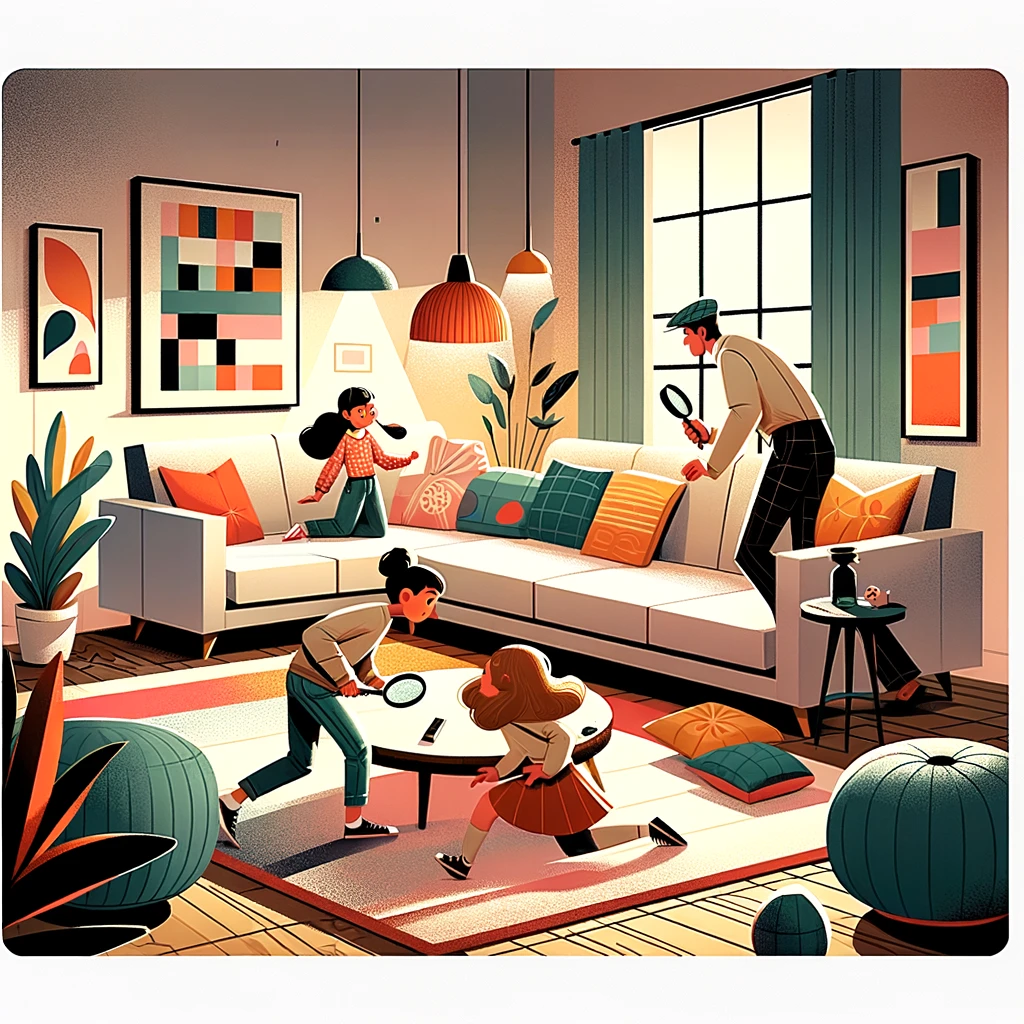
Release the hunters. Your job is clue-clarification hotline and misdirection service ("cold... colder... have you considered the airing cupboard"). Mixed ages hunt fairest in pairs — a big kid's reading plus a little kid's low-level eyesight is a genuine team.
The judging
Finds laid out per hunter, each clue's answer presented and argued for — the arguing is the point, and creative interpretations score full marks when defended well ("it IS softer than a cat if the cat is cross"). Points, prizes, and everything returned to where it lives, which is the hunt's quiet second lap.
Make it fit your kids
Three clues, all colours and textures, hunted with a partner who can read — their triumph at "something yellow" is fully sincere and the basket-carrying is half their joy.
The stampede years — ten clues, a timer, and judging-table advocacy of surprising sophistication. They'll demand to write the next list immediately; let them.
Riddle clues, a points system with bonuses, and the list-writer role in rotation — writing good clues is harder than solving them, which they discover with respect.
They'll hunt if the clues are genuinely clever or the prize is real — better, they make devious lists for the youngers and run the judging with game-show energy.
Free forever — paper, a pen and the house you already have. The biscuit prize economy has never needed inflation.
If it’s going really well
- The photo hunt variant — finds photographed in place instead of fetched; nothing to tidy and the evidence gets reviewed on the sofa.
- Clue-chain mode — each find contains the next clue, which is a treasure hunt, which is an escalation the family will demand eventually.
- The standing Sunday hunt — a laminated list format and a rotating list-writer make it a fixture that costs nobody prep.