Create Your Own Superhero
Half a day of character design and comic-making. Each kid invents a hero with a full file — power, fatal flaw, origin story, arch-enemy — then produces issue one of their adventures. All the superhero energy, none of the cushion-course cardio.
Last updated
Before you start
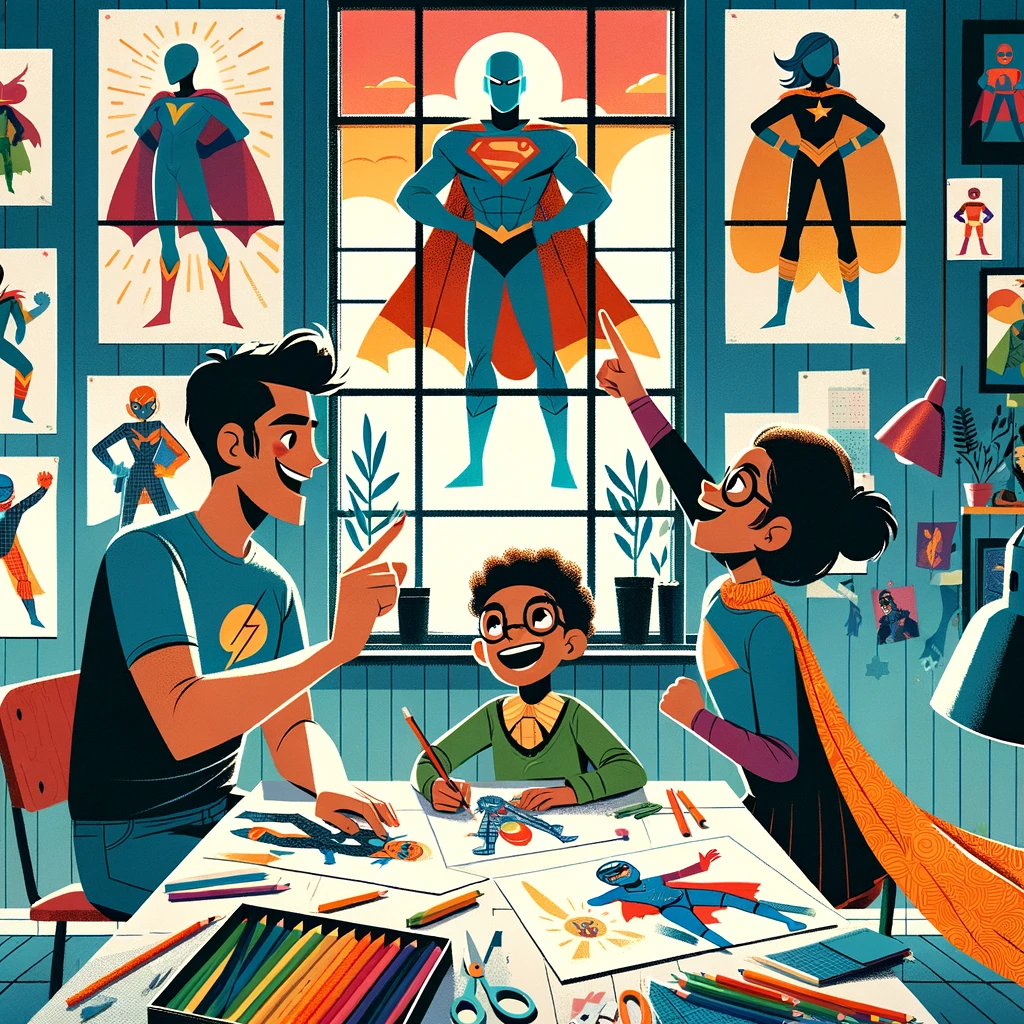
This is the drawing-table version of hero play — for the kid who'd rather design the cape than wear it, or for the afternoon after Superhero Day when the characters exist but their stories don't. The output is a character file and a first comic or illustrated story, which beats a loose drawing because files and issues imply more to come.
The creative rule that makes heroes interesting: the weakness and the enemy get designed before the powers. A hero designed powers-first can do everything and therefore does nothing. Start with what they fear, what beats them, who's against them — then the powers have something to strain against, and the story writes itself out of the gap.
How it goes
The character file
Work through the file together, weakness first — every hero answers the same form. Name, origin (one paragraph — the accident, the discovery, the bite), power, the weakness, the arch-enemy and their motivation. Then the full-page costume schematic with labelled arrows ("cape — detachable", "boots — jump 50 metres"). Labelled arrows are irresistibly official.
Story planning
Issue one gets the classic three beats — enemy does something bad, hero responds and fails (the weakness), hero wins anyway (cleverness, a friend, courage). Plot it as three quick thumbnail sketches. The fail-then-win shape is the whole of storytelling, learned in one sitting.
Making the issue
Fold the booklet, rule rough panels, and go — drawings with captions for younger makers, panels and speech bubbles for older ones. Spelling stays as-is; corrections kill momentum and the misspellings become beloved canon. You're on request-drawing duty only ("draw me a van, I'll do the rest").
The launch
Cover art, issue number, a price in the corner (they always want a price). Then the reading — each creator presents their issue aloud, dramatic voices encouraged. Files and issues go into the official archive box, because issue two is now inevitable.
Make it fit your kids
They dictate the file while you scribe, then draw the hero as only they can. Their power will be something like "being very fast asleep" and it must go in the file verbatim.
The heartland — earnest files, elaborate schematics, comics where the villain surrenders because the hero asked firmly. Fold them extra booklets; issue one leads to three.
They'll want lore — team-ups between siblings' heroes, shared universes, a map of the city. Grant it all. The crossover issue is the afternoon's blockbuster.
Pitch it as character design or zine-making, not superheroes — same activity, different wrapper. A teen with fineliners and an anti-hero brief produces something genuinely good, then denies caring.
Paper and pencils, full stop. The folder is a cereal box flattened and relabelled CLASSIFIED, which is arguably better.
If it’s going really well
- The shared-universe wall — heroes, villains and locations mapped with string like a conspiracy board.
- Photocopy issue one and post copies to grandparents with a subscription invoice.
- The live-action adaptation — Superhero Day, cast entirely from the files.